
School Enrolment Crisis : Demographic Shifts and Policy Implications
Context
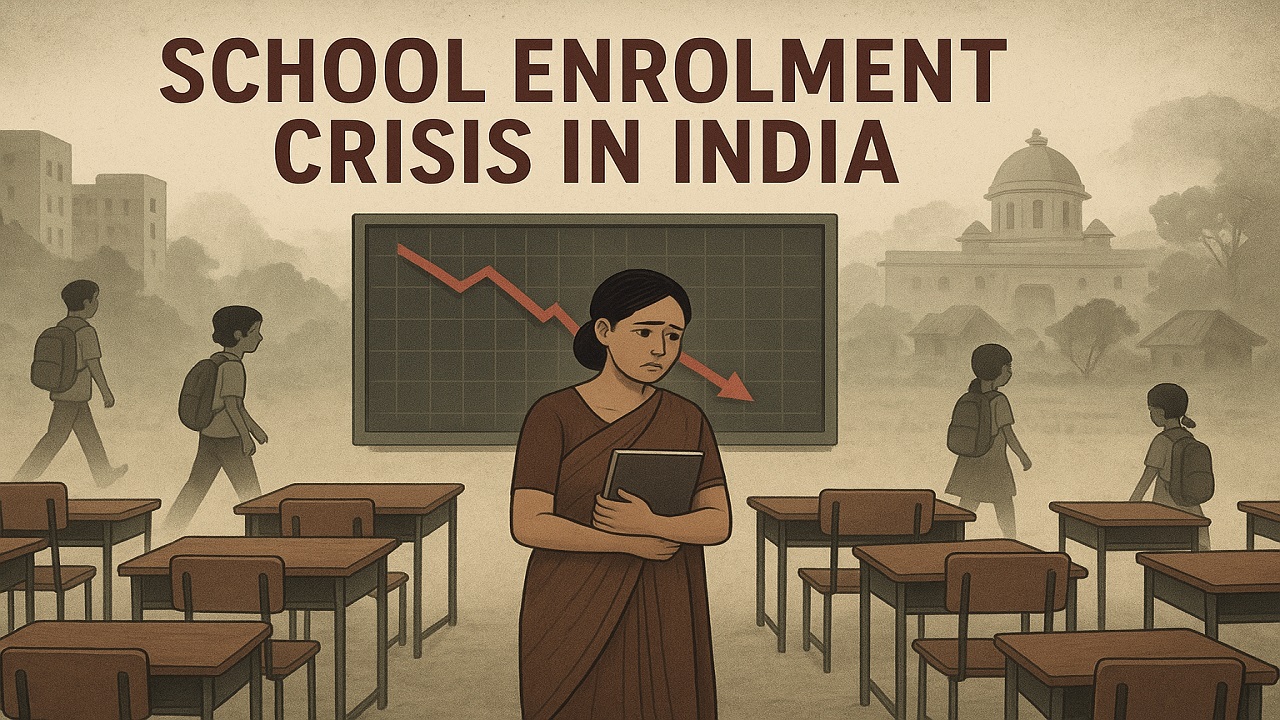
The Unified District Information System for Education Plus (UDISE+) 2023-24 report, released by the Ministry of Education, has revealed a worrying decline in school enrolment. The sharpest fall is seen among children aged 3 to 11 years, raising concerns about demographic trends, resource allocation, and the future of India’s education sector.
Body
Issue Highlighted
- Total enrolment (Class 1-12) dropped by 11 lakh, from 24.8 crore (2023-24) to 24.69 crore (2024-25) — the lowest since 2018-19.
- Children aged 3-11 years (Anganwadi, Pre-school, Class 1-5) fell by nearly 25 lakh in 2024-25 compared to the previous year.
- Enrolment in foundational & preparatory stages declined from 12.09 crore (2023-24) to 11.84 crore (2024-25).
- Over the last decade, numbers have fallen consistently — from 26.3 crore (2012-13) to 24.69 crore (2024-25).
Causes of Decline
- Falling birth rates
- India’s Total Fertility Rate (TFR) has dropped to 1.91 per woman (2021), below the replacement level of 2.1.
- Except Uttar Pradesh, Bihar, and Meghalaya, all states have fertility rates below replacement level.
- Fewer births directly mean fewer school-age children.
- Shift towards private pre-primary institutions
- Many children attend standalone private pre-schools, not fully captured in UDISE+ data.
- Methodological changes in data collection
- 2022-23 and 2023-24 reports are not directly comparable to earlier years due to revised methodology.
- Estimates are still based on 2011 Census population figures, likely to be updated after the 2026 Census.
Positive Outcomes in the Report
- Rise in enrolment at higher levels
- Middle school (Class 6-8): From 6.31 crore → 6.36 crore.
- Secondary school (Class 9-12): From 6.39 crore → 6.48 crore.
- Improvement in Gross Enrolment Ratio (GER)
- Middle school GER: From 89.5% → 90.3%.
- Secondary school GER: From 66.5% → 68.5%.
- Dropout rates reduced
- Preparatory stage: From 3.7% → 2.3%.
- Middle school: From 5.2% → 3.5%.
- Secondary school: From 10.9% → 8.2%.
- Better teacher-student ratio (2014-15 vs 2024-25)
- Foundational stage: From 1:15 → 1:10.
- Preparatory stage: From 1:18 → 1:13.
- Middle school: From 1:26 → 1:17.
- Secondary school: From 1:31 → 1:21.
Facts:
- Full form: Unified District Information System for Education Plus.
- Prepared by: Department of School Education & Literacy (DoSE&L).
- Released by: Ministry of Education.
- Aim: “One Nation, One Database” for school education.
- Coverage: Tracks 60+ data fields per student.
- Unique ID: Generates an Educational ID (EID) for every student across India.
Conclusion
The fall in enrolment among 3–11-year-olds reflects structural demographic changes, driven largely by declining fertility rates and shifting preferences towards private pre-primary institutions. While this suggests population stabilization, it poses challenges for school resource planning and long-term educational strategies. However, the report also highlights positive trends — improved GER, reduced dropout rates, and better teacher-student ratios — indicating progress in educational quality and retention. The upcoming 2026 Census will provide more accurate data for evidence-based policy decisions.
Source : The Hindu