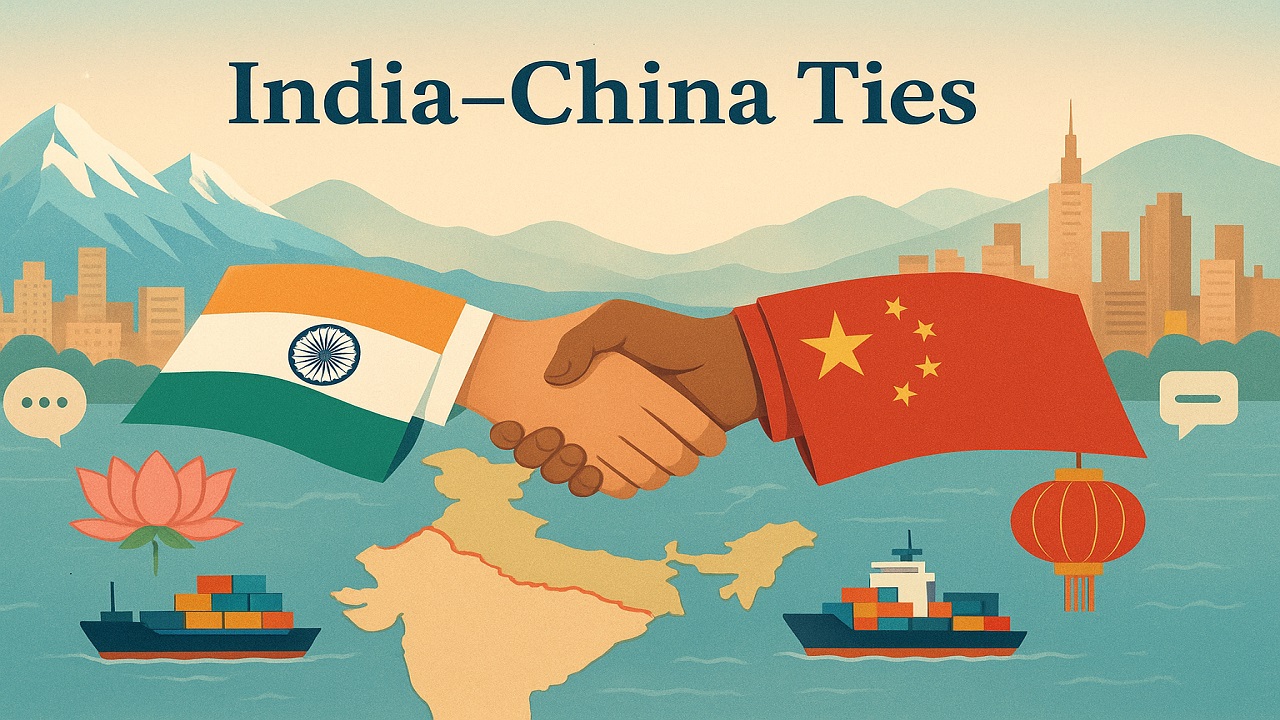
India–China Ties: Balancing Border Peace and Strategic Cooperation
Context:
- At the SCO Summit 2025 in Tianjin, Prime Minister Narendra Modi and Chinese President Xi Jinping held bilateral talks, emphasizing peace along the border and exploring avenues for expanded cooperation.
- The discussions underscore the continuing relevance of the Panchsheel Doctrine as a guiding principle in India–China relations, despite historical tensions.
1. Background of Panchsheel
- Panchsheel (Five Principles of Peaceful Coexistence) was articulated in the 1954 Agreement on Trade and Intercourse with Tibet.
- Five Principles:
- Mutual respect for sovereignty and territorial integrity
- Mutual non-aggression
- Mutual non-interference in internal affairs
- Equality and mutual benefit
- Peaceful coexistence
- Championed by Jawaharlal Nehru and Zhou Enlai; later integrated into:
- Bandung Conference (1955)
- UNGA Resolution (1957)
- Non-Aligned Movement (1961)
2. Current Context of India–China Relations
- Post-Galwan tensions (2020): Relations strained due to LAC disputes; disengagement partially achieved.
- Recent engagement: Both sides emphasize “development partners, not rivals.”
- Xi Jinping’s four-point plan:
- Deepen mutual trust
- Strengthen strategic communication
- Expand cooperation
- Safeguard common interests
- India’s stance: Border peace is a precondition for stable ties; relations should not be viewed through a third-country (US) lens.
3. Strategic Importance of Panchsheel
For India:
- Provides a moral and diplomatic framework rooted in non-alignment and independent foreign policy.
- Reinforces sovereignty and equality in dealings with larger powers like China.
- Maintains strategic autonomy, avoiding bloc alignment.
- Projects India as a responsible regional power committed to peaceful coexistence.
For China:
- Projects a benign global image to counter perceptions of assertiveness.
- Frames ties as cooperation and mutual respect, not confrontation.
- Provides a diplomatic shield to justify policies under peace and equality.
- Softens its rise narrative, presenting China as a partner in regional stability.
4. Global Relevance of Panchsheel
- Supports multipolarity, balancing against single-superpower domination.
- Reflects South–South solidarity, advocating fair global governance.
- Offers an alternative to bloc politics, promoting coexistence over rivalry.
5. Challenges in Implementation
- Border clashes: Incidents like Doklam (2017) and Galwan (2020) weaken trust.
- Trade asymmetry: Bilateral trade favors China, leaving India with a ~$100 billion deficit.
- Sovereignty concerns: Projects like BRI and CPEC through PoK, and Chinese naval presence challenge India’s territorial integrity.
- Geopolitical balancing: India’s engagement with QUAD and the US perceived as a containment strategy, increasing Chinese suspicion.
6. Opportunities for Cooperation
- Economic collaboration: Technology, renewable energy, and pharmaceuticals.
- Multilateral platforms: SCO, BRICS, G20 to counter Western dominance.
- Global reforms: Cooperation on WTO reforms, climate action, UNSC restructuring.
- Cultural links: Buddhism, pilgrimages, tourism strengthen people-to-people ties.
7. Way Forward
- Reaffirm Panchsheel: Principles to guide border dispute resolution.
- Confidence-building: Hotlines, joint patrols, local agreements along LAC.
- Issue-based cooperation: Areas like climate change, counter-terrorism, fair trade.
- Regional forums engagement: SCO, BRICS, Indo-Pacific dialogues.
- Balanced economic strategy: Reduce import dependence on China; explore complementarities.
Conclusion
- The Panchsheel doctrine, tested over decades, continues to shape India–China engagement.
- The 2025 revival shows that border tensions must not overshadow peaceful coexistence and stability.
- India’s task is to balance national interests with Panchsheel’s spirit, drawing lessons from history while maintaining sovereignty, strategic autonomy, and regional responsibility.
Source : Indian Express