
Central Indian Ocean Sea-Level Surge: Historical Evidence and Implications
Context:
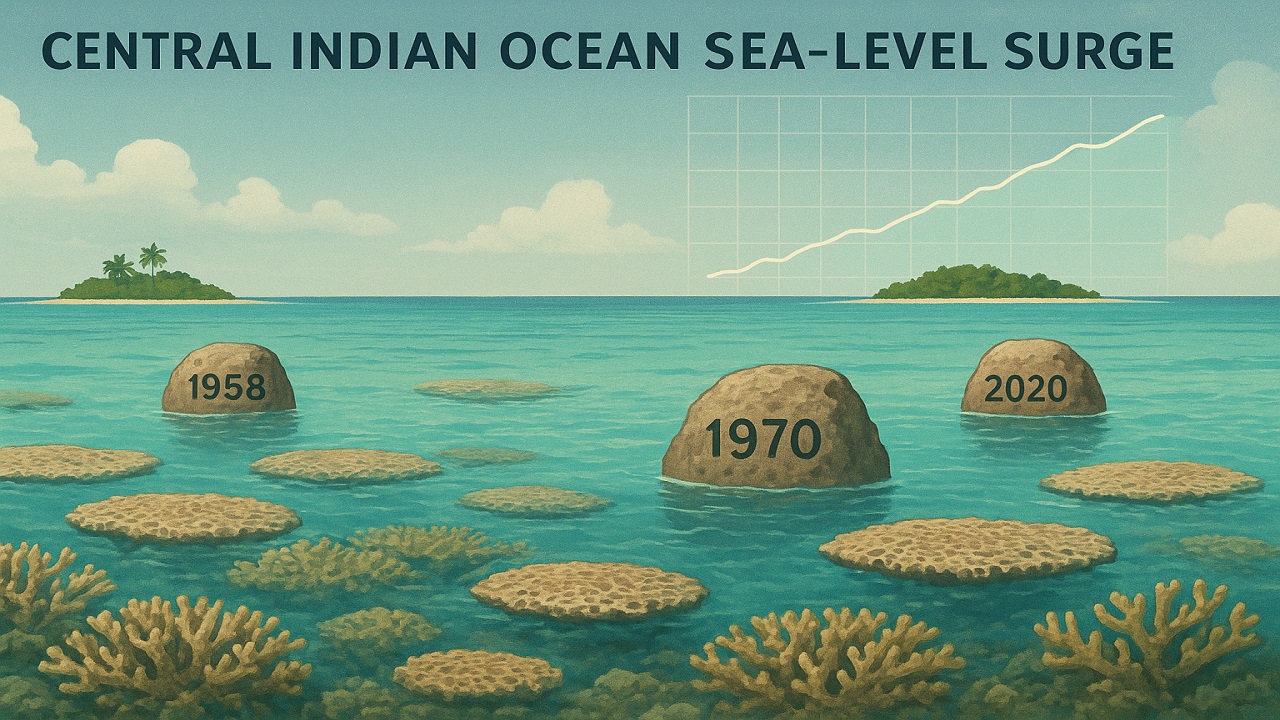
A recent study on coral microatolls in the Maldives indicates that sea levels in the central Indian Ocean have been rising steadily since the late 1950s, challenging earlier beliefs that significant acceleration began only in the 1990s. Understanding this trend is crucial for island nations like Maldives and Lakshadweep, which are highly vulnerable to rising seas.
1. Sea-Level Rise in Maldives & Lakshadweep
- Long-term increase: Approximately 0.3 m from 1930–2019, confirming sustained acceleration.
- Rise rates over different periods:
- 1930–1959: 1–1.8 mm/year
- 1960–1992: 2.7–4.1 mm/year
- 1990–2019: 3.9–4.8 mm/year
- Average rise since 1959: 3.2 mm/year, increasing to about 4 mm/year in the last 20–30 years.
- Cumulative impact over 50 years: 30–40 cm rise in the region.
2. Key Findings
- Earlier acceleration: Sea-level rise began in the 1950s, not the 1990s.
- Coral microatolls as natural archives: Coral growth bands and uranium dating provide precise long-term sea-level records.
- Influence of climate events: Coral interruptions are linked to El Niño, Indian Ocean Dipole (IOD) events, and lunar tidal cycles.
- Regional differences: The central Indian Ocean experienced faster and earlier rise than coastal regions due to unique oceanographic factors.
3. Causes of Sea-Level Rise
- Thermal expansion: Warming oceans expand, steadily raising global sea levels.
- Glacial and ice-sheet melting: Meltwater from the Himalayas, Arctic, and Antarctica contributes significant freshwater to oceans.
- Indian Ocean warming: Above-average heating intensifies currents, causing higher local sea-level rise.
- Climate variability: El Niño, IOD, and wind shifts amplify regional sea-level fluctuations.
4. Implications
Ecological:
- Reduced sunlight for corals
- Coral bleaching and reef degradation
- Coastal erosion and biodiversity loss
Social:
- Risk to low-lying communities in Maldives and Lakshadweep
- Potential forced migration and displacement
Economic:
- Fisheries and tourism, key to island economies, face long-term losses
- Infrastructure along coasts is increasingly vulnerable
Geopolitical:
- Rise in climate refugees
- Strain on governance and regional security mechanisms
5. Way Forward
- Monitoring & Research: Use coral microatolls, tide gauges, and satellite data for precise long-term tracking.
- Coastal resilience: Implement mangrove restoration, seawalls, and climate-resilient infrastructure.
- Regional cooperation: Indian Ocean Rim nations must coordinate adaptation strategies.
- Global climate action: Meet Paris Agreement targets to reduce emissions and slow ocean warming.
- India-specific focus: Prioritize Lakshadweep, conserve ecosystems, enhance disaster preparedness, and invest in adaptation.
Conclusion:
Sea-level rise in the Indian Ocean is occurring earlier and more sharply than previously assumed, posing a severe threat to island and coastal communities. Coral microatolls provide essential historical evidence for improving future projections. Immediate action through adaptation, regional cooperation, and emission reduction is critical to protect the ecological, social, and economic well-being of the region.
Source : The Hindu